Randy Newman seems to me like a completely unlikely person. Whereas so many singer-songwriters work in the heart-on-the-sleeve, confessional mode, his songs are mostly cynical and distant. His voice is nothing to write home about, plus his appearance doesn't scream "big star." Somehow, these factors add to his music. His songs about sexual deviants and con artists wouldn't be as powerful if they came out of a more conventional personality.
His ability to create rhetorical distance between author and narrator is right up there with Stravinsky. A song like "Rider in the Rain" is so absorbed in being "cowboy music," but this involvement is matched by a feeling that it's all an elaborate conceit. Newman uses this rupture to test your trust in the narrator. Because the writing is so disquietingly conventional, you examine it all the more closely for the cracks in the facade. He forces you to think about how genres are used, what images are conjured up by particular instrumental forces, and the weight you give to the words of singers. His voice is that of an outsider, always shrewd and subversive.
Andriessen and Schönberger wrote in The Apollonian Clockwork about how when Stravinsky wrote a Mass or a Requiem, it became an ür-Mass or ür-Requiem, a summation and a stepping beyond of the genre. When Randy Newman writes a song, he (and the song in a way) are so aware of the genre's conventions that a similar kind of commentary is embedded in it. Tom Waits has often been described as a "meta-songwriter," but I think that Newman is far more deserving of the title.
November 29, 2005

November 19, 2005
Peter Garland: Americas
A few things are worth saying about this set of essays. Garland has a couple loose histories of the use of percussion and the piano in American music, but the majority of the collection is devoted to his journals and appreciations of fellow artists. The writers and composers featured often rejected the mainstream culture of the 20th century for a life of wandering and solitude (Paul Bowles got a pretty extensive write-up).
A number of these people, Harry Partch in particular, also tried to rekindle an animistic attitude towards religion (or as Garland would argue, religion in general). Garland feels quite strongly that religion died in the 20th century and that our collective quality of life has suffered for it. In order to revive the kind of religion that Garland thinks everyone should have, a prominent spiritual leader would have to be embedded in local communities. This person would help mediate social relations and in general make sure everyone was happy.
The key is being embedded in the community. Garland's identity as a lonely wanderer is a bit at odds with this. The tone I read in his essays suggested that he was going to set down his ideas, but that they'd be understood and implemented at a later time (beyond his lifetime?). This attitude just screams Romanticism. He's of course entitled to his opinions and how he wants to express them, but I can't help but feel he could find a means of expression more in tune with his thoughts.
Also, I would question whether or not there are other institutions today that accomplish the same social functions as his conception of religion would. When someone posts a discussion topic over at the Composers Forum or any other online forum, doesn't that act serve to bring people together and increase their understanding of one another? I'm also not sure how religious figures today fail at this role. If anything, the rabbis and ministers I've come in contact with seem more concerned at doing this kind of service than anything else. Think of the character of Eccles in Rabbit, Run. He puts an incredible amount of energy into trying to straighten Rabbit out.
The thing I really took away from the book was a better feeling of the tradition running through the American experimental tradition. It's easy to portray Partch, Cage, Cowell et al as only being united in their defiant attitudes, but Garland shows there's more to them than that. There's a full-page headshot of Varèse with his trademark I-could-kill-you-just-by-thinking-it look, but there's another shot showing him sitting next to Cowell, who's playing the shakuhachi for him. Garland shows that even though the styles of these composers are quite individualized, they influenced each other quite a bit in the development of their ideas.
November 17, 2005
A Literary Echo
From "More Light," Morton Feldman:
Will blog later on this Garland book once I get through it. It's got its share of thought-provoking bits, particularly on the idea of tradition among quote-unquote maverick composers.
In effect, what I am suggesting is not that music should explore or imitate the resources of painting, but that the chronological aspect of music's development is perhaps over, and that a new "mainstream" of diversity, invention and imagination is indeed awakening. For this we must thank John Cage.From "Oaxacan Journal" in Americas, Peter Garland:
In benign and far-reaching ways, he has helped and influenced all of us . . . Listening to any of the sets of records he edited for Folkways, Music of the World's Peoples, will give a sense of his continuing legacy: if, in this century, the past, present and future have been unlocked, and the variety of the world's cultures opened to us, we have Henry Cowell, more than anyone else, to thank.
Will blog later on this Garland book once I get through it. It's got its share of thought-provoking bits, particularly on the idea of tradition among quote-unquote maverick composers.
November 05, 2005
Garlandia
Yesterday I ended up listening to some of Peter Garland's piano music, reading some of his essays, and thumbing through some old copies of Soundings (thank you, extremely comprehensive music library!). His music is really shocking in its simplicity. "Radical consonance," the term used in the liner note bio, is an appropriate description. The shock is because the process that led to the music is a mystery at first hearing, and you're not sure if there was a high-level one going on. Music with a complex surface gives you the "assurance" that even if you don't know what the hell is going on, everything's probably very well thought-out. Alternatively, with process-y minimalism, if you don't know how the music was put together, you're just not paying attention.
With Garland's "minimalism," you become enamored by the simple beauty of the music, but afterwards find yourself asking very basic questions about it. So many things recur, chords, rhythms, that you want to know why he chose those ideas (whether or not that's a question worth answering isn't clear now). He makes no effort to hide them behind a developmental process, so they feel very exposed at all times. They're like little gifts being offered to the listener on nothing more than good faith. It's not often total strangers are so generous. You wonder, "Why me? What did I do to deserve this?"
His writing is similarly simple and generous. Kenneth Patchen's Journal of Albion Moonlight is not a completely unfair comparison. Though Patchen's work is far more lyrical and even more heart-felt, both writers are strongly attuned to an intense tragedy in everything that they see. This sense remains very tangible no matter how unclear the subject of their writing is. All in all, his work is the kind that lingers, that shoots with force into your thoughts hours after you experienced it. Definitely worth some further exploration.
October 23, 2005
Recent Listening
Cold Blue Complete 10-Inch Series
It's easy to forget about California. Aside from the occasional glamorous premiere, it's...you know... all the way over there. East coast pretensions aside, it's inspiring to see such sophisticated and flat-out beautiful music outside of the classical mainstream. Every time I hear something from Daniel Lentz, he just seems more and more like an undeservedly under-appreciated composer. That Gann guy might be onto something...
Nude Rolling Down an Escalator
Speaking of which, I finally got a chance to sit down with Kyle's Disklavier studies. I could see these becoming very popular if they were heard by people who aren't necessarily connoisseurs of 'serious' music (where's our post-classical A&R rep...or is that Kyle?). Texarkana is laugh-out-loud funny and Petty Larceny bears a freakish resemblance to the sounds in my sleep-deprived mind the night before a music history exam.
Stravinsky and Stravinsky
The wind ensemble at Eastman just did a concert bookended by the Octet and Symphonies of Wind Instruments. Among other things, it confirmed my thought that Stravinsky, perhaps more than other composers, really needs to be heard in person. For one thing, his ensemble choices often have striking presences on stage. When I first saw Symphony of Psalms, I had an experience similar to those New Yorkers who thought a UFO landed when the Guggenheim came to town. In the Octet, there was something just intriguing about the three pairs and a couple loners. Seems like a great-uncle or something to Carter's Triple Duo.
I don't know if this is a stretch, but the physical gestures needed to produce the sounds seemed linked in character to the sounds themselves. All the head bobs and 1-2 1-2 breathing felt like expressions of the same underlying idea.
Lastly, the sounds. Particularly in Symphonies. It's just full of killer sonorities. There were a couple other piecs on the program based on chorales. To my ears, their sonorities were a little off-balance. They were essentially solid, but they had a few parts which felt glued on — flute solos which got too glossy and some bass brass that overwhelmed the texture a little much. Stravinsky... when he laid down a chord the harmonic structure just felt total. Everything flowed smoothly, from the ground all the way up. Perhaps composition curriculums would benefit from the addition of a requirement in masonry...
October 14, 2005
Music as an Aesthetic Object
Composers often get asked about how they write. Most recorded answers are as ridiculous as the question itself is. Debussy said something like “I start with all the notes, get rid of the ones I don't want, and keep what's left.” Works of art are such peculiar beasts because they show so much, yet they always show it in such odd and oblique ways. The question of compositional process pokes not at the truths themselves, but why they needed to take on unfamiliar shapes. The causes aren't gossipy tales of past lovers and family turmoil, but whatever lies at the center of one's self. To explain these things would almost be to destroy them. Or as Pinter said to an actor who inquired about his character's past life: “None of your fucking business.”
Nevertheless, these causes can become quite an obsession. When I first see a score to a well-loved piece, it's as if all its secrets will finally be revealed. I half-expect angels to descend from the heavens (harps in hand) to provide proper accompaniment as I turn to the first page. I really should get over the anti-climax of it. The plain appearance of the notes in print makes them seem even more out of reach.
As I see it, there are two (admittedly exaggerated) stances to take at this point. The first is that one can come to know music by way of thorough analysis. If I tear those notes apart, I will understand how they relate, and this understanding is the music. The other point of view is that art is fundamentally non-understandable, and is at best a tool for expanding one's various comfort zones (emotional, ideological, etc.). Interestingly, these two tacks engage separate senses. Analysis is primarily a visual activity, while you throw the score aside to more fully use your ears. Of course, the reality is that you hover between these two absolutes whenever engaging music.
Try as I might, though, there are some pieces that just resist being read into. I feel deadlocked in my efforts to penetrate Stravinsky's Apollo. The writing is just so of a piece. It feels like it was conceived all at once. Its architecture can be elusive, though it does open after persistent examination. The emotional content is surprisingly generous for Stravinsky (the Pas de Deux verges on being sentimental).
Nonetheless, there seems to be an upper limit to the level of intimacy I can reach with this piece. Even when I feel secure in my intellectual understanding of any of its remarkable features, the listening experience seems to exist in ignorance to what I know about the notes. That knowledge only seems to provide a comfort (a false one maybe), a way of not being completely overwhelmed by the sounds.
What meaning this piece has seems most accessible by denying contact with these causes of construction. It has the most life for me as a purely aesthetic experience. I can marvel at its assembly or use its emotional peaks to get a better grip on my own, but the piece's only unified statement seems to be in its attitude towards music. I don't mean that Apollo should be read as a ballet “about” the major triad; I mean that it has in it a way of looking at the function of music. Stravinsky often writes with a mystical attitude, suggesting that music is as fundamentally unknowable as a religious higher being. This stance can be hard to reconcile with the concrete nature of sound and notation, but the resulting music begs to differ.
October 08, 2005
Heebie McJeebie, I presume?
Inspired by Prof. Heebie McJeebie's recent podcast, I thought I would go seek him out. Rochester music community being what it is, I'm surprised I hadn't run into him already. I went over to the Hotel Cadillac and asked for him at the front desk. Unfortunately, I was told that he was out-of-town for the weekend. Even though I missed him, I think I found his hang out.


Yup.
Yup.
October 05, 2005
Music as Other Senses
There's a certain type of piece that begs to be perceived visually to me. I'm thinking of music that has such vivid textures and contrasts that you can follow it in terms of the interplays of qualities of sound. The earliest examples of this I can think of are in Beethoven, like the slow movement from the Fourth Piano Concerto or the opening of the Ninth Symphony. Ligeti has a knack for writing music like this. There are a number of examples just among his piano études. Incidentally, composers with strong ties to the visual arts, such as Debussy and Feldman, do not elicit this reaction from me. Music in which I can see a plot lurking about that's constructed in terms of sound-color synesthesia is of a completely separate nature (Messiaen, obviously).
I guess what I care about aren't these specific examples of sound to vision translation, but the idea of perceiving aural events as if they were something else, a kind of artificial synesthesia. This cross-sensory action isn't a result of an oddly wired brain (I think); it's created for "practical" reasons. The opening of Beethoven's Ninth is supposed to sound like it's creating itself, emerging out of a void. You can listen to it in terms of a straight harmonic progression, but it's more attractive to me to hear it as a kind of dance emerging from the darkness. Thinking of the kaleidoscopic counterpoint of "Arc-en-Ciel" as if it truly is light refracting through water droplets makes the music that much more vivid.
These examples seem intentional to me, as if these composers' conceptions could not be limited to one sense. Anyone else have similar listening experiences? Any composers in the audience care to share if they've explicitly tried to create such moments?
September 25, 2005
Music as a Record of Social History
Lately, I've been relistening to Whatever and Ever Amen. While I haven't done an exhaustive tour of Ben Folds's discography, it seems like it's easily the best thing he's done. Some songs on it, like "Kate," explain perfectly why pop music is essential. One thing that struck me about the album, though, is how rooted it is in mid- to late-90s apathy. While I prefer not having to acquiesce control of my emotional states to any collective consciousness, it's hard to deny that a lot of people feel similar things at the same time. Though high artists like to stick to the timeless and universal, popular culture happily reflects what's "in the air."*
While on the zero to Beethoven metric of artistic success, efforts like these can fall somewhat short, they seem rather valuable to social historians. I probably won't care very much about this album in 20 years, but if someone wants me to "explain the 90s," I'll pull it out and play "Battle of Who Could Care Less." It sums up quite economically the shared feelings of the time, how people related to one another, and how they spent their free time. I just hope I won't be asked what it means to be "dressed up all like The Cure."
---
*This is probably one reason why Folds's career has lagged as of late. His recent songs feel a little mired in the same old mix of nostalgia and apathy.
September 22, 2005
Classroom Notes
People who complete orchestration assignments with the full battery of extended techniques are like people who write papers with a thesaurus in their lap.
August 11, 2005
Chiseling Away at the Iceberg
My mother, ever patient with my musical interests, will listen to just about anything I want to play for her. She deserves much credit, for she still keeps an open ear even after hearing some pieces that had her question whether I was even playing music for her (Bartok and Carter she no like). Even after giving her what seems like a minor education in modern music, she has only cared for the following:
If there's a “lesson” in this, it's not that people will like new music if you cram it down their throats enough (though I think this is the first time my mom's been drawn to a piece for an essentially intellectual satisfaction). My guess is that she liked the music because it met her on territory she was comfortable in. Though she hasn't touched the instrument in a while, my mom took piano lessons throughout the early part of her life. Though Rzewski's style of virtuosity was certainly new to her, she was able to relate it her knowledge of the instrument. Instead of being repelled by his style, it intrigued her.
I guess this situation speaks more to developing musical literacy than a taste for the new. Whenever non-musical friends ask me to “teach them about music,” I just tell them to listen to a lot of music (with carefully curated suggestions of course ;)). It's possible to appreciate music just out of the pleasure certain sounds bring, but a deeper appreciation comes from picking up on the practices that have persisted throughout its history. Like with any other language, the only way to gain fluency is through immersion.
My mom's knowledge of idiomatic piano writing spelled the difference, so far as I can tell, between her liking the piece and it being another instance of me playing unseemly “sounds” for her. I don't have any high expectations about further emendations to the list above, but it's nice to see that it wasn't as closed a book as I thought it was.
- Ives (admittedly his more traditionally tonal works), in particular his Second Symphony
If there's a “lesson” in this, it's not that people will like new music if you cram it down their throats enough (though I think this is the first time my mom's been drawn to a piece for an essentially intellectual satisfaction). My guess is that she liked the music because it met her on territory she was comfortable in. Though she hasn't touched the instrument in a while, my mom took piano lessons throughout the early part of her life. Though Rzewski's style of virtuosity was certainly new to her, she was able to relate it her knowledge of the instrument. Instead of being repelled by his style, it intrigued her.
I guess this situation speaks more to developing musical literacy than a taste for the new. Whenever non-musical friends ask me to “teach them about music,” I just tell them to listen to a lot of music (with carefully curated suggestions of course ;)). It's possible to appreciate music just out of the pleasure certain sounds bring, but a deeper appreciation comes from picking up on the practices that have persisted throughout its history. Like with any other language, the only way to gain fluency is through immersion.
My mom's knowledge of idiomatic piano writing spelled the difference, so far as I can tell, between her liking the piece and it being another instance of me playing unseemly “sounds” for her. I don't have any high expectations about further emendations to the list above, but it's nice to see that it wasn't as closed a book as I thought it was.
No Words
Recent library trip brought back my first Joan Baez album, Diamonds and Rust. I have no idea if this is a "proper" starting point for her music, but I don't think it matters. I've listened to the album several times already and have barely been able to follow the words; the richness of her voice takes over my ear. It's like one of those glasses of red wine that your tongue touches more than it tastes. I don't think the tone quality of an instrument has captivated me this much before. The Joan/Joni duet at the end is just icing on the cake.
July 21, 2005
Elaboration
I'm a big fan of examining the preliminary work that leads up to the completion of a creative project. It was a pleasant surprise to find a little collection of that work not for music or painting, but a computer program. Sitting at the bottom of this interview is a chronologically arranged set of sketches and mock-ups for Delicious Library, a media library program for the Mac. I'm stuck behind a PC keyboard, so I haven't had a chance to try it out myself, but by all accounts it's sensitively designed with a fine eye towards detail. It's terrific to get a peek at the creative process behind it.
July 20, 2005
Some Good Record Store Advice
"Would you say that this is political music?"
"No, there's not a lot of screaming about Che Guevara or anything like that."
"No, there's not a lot of screaming about Che Guevara or anything like that."
Complexity
There have been a couple posts (no permalink, see post "Quotes") made recently on complexity. One of the defenses of yer complex high modernism is that life is complicated, so we must make music to match its complications. This is a weak defense because it entangles two unrelated issues: complexity of language and complexity of expression. Consider Milton Babbitt's extremely florid prose. His baroque diction takes some adjusting to when you sit down to read one of his articles, but after you become acclimated to it, it reads fairly smoothly. One of the reasons, I think, is that what he's saying isn't all that complicated. His style sets your mind on the defensive, ready to receive a long stream of thorny thoughts. There's some confusion when you realize that stream's not going to show up, but afterwards you can almost coast through his text. The elaborate constructions provide a kind of cushioning for your eyes. On the other end of the spectrum is Morton Feldman's prose style, where the nonchalant delivery belies the knottiness of his thoughts.
The danger is assuming that these two elements, language and expression, are tied. While the type of language you use does indeed express something, it is not the core of the expression. My perspective is that it provides a context for the expression itself. Having to acclimate to a foreign language puts your mind in a certain state, which can assist in the ultimate expression sought by the composer. I would hesitate to say that all of yer complex high modernism needs to slim down a little, because the overall expression would change significantly.
The rotten side to this is when language replaces expression. It's rotten not because nothing is expressed ("We have nothing to say and we are saying it - that's poetry."), but because it veers away from art into mere intellectual flattery. Listening can too easily become a game of connecting syntactic dots, picking out allusions, and affirming coherency. An overly complex language can, ironically, encourage intellectualizing and simplifying. While these are certainly elements in the modern world, whether they are elements that one wishes to express is a question left to the composer.
July 03, 2005
July 4th Heads-Up
WHRB gets a decent bit of attention in the blogging community for their comprehensive orgies. Tomorrow, in honor of Independence Day, their programming from 1-10pm EDT will be devoted to American music (how rare!). In the past, they've aired unusual selections like a few art songs/ad jingles for toothpaste and Virgil Thomson's ballet Filling Station. They don't touch the American experimental tradition much (the on-air announcement for the program yesterday mentioned the inclusion of modern composers like Piston and Harbison), but it's definitely an event worth tuning /streaming into. If only they didn't need a holiday as an excuse to play so much American music.
June 30, 2005
Feldman and Cassavetes
When drawing comparisons to other media, Morton Feldman's music often shows up next to the plays of Samuel Beckett. Not only do their minimal landscapes resonate with each other, but Feldman was quick to compare their work, even citing the ease with which the two got along. However, for the purpose of investigating his musical innovations, it would make sense to compare his achievements with the films of John Cassavetes (this link is maintained by Ray Carney, who does for independent film what Kyle Gann does for Downtown music).
Cassavetes's movies are marked by inarticulate characters, long takes, and rough technique. Feldman's music reveals its maker in at least one way, its myopic interest in each sound. Its striking sensuality often wins fans, even if they admittedly can't make any sense of the music. The visceral rawness of Cassavetes's work usually isn't as endearing.
Audiences often find a “rambling” quality in their work. Cassavetes let scenes run as long as he felt necessary. The suicide scene in A Woman Under the Influence is unrelenting. Similarly, Piano and String Quartet plays on each fragment for calmly extended periods. The proportions of both works are nothing like a Hollywood drama or a Classical sonata. Cassavetes's insistence on honest emotions led him to eschew simplified narratives. Feldman similarly refused to “push the sounds around.” These unusual aesthetics obscure the presence of form, but they don't deny it. Though detractors may insist their work is formless, both derive forms from the characteristics of their content.
Opening Night, at its surface, is the story of a new play moving from New Haven to its Broadway premiere. The production faces problems as its lead must reconcile her own problems with aging with those of her character. Tracing this idea more closely, one finds women's reactions to getting older to be central to the film. Viewed through this lens, just about every scene provides a different perspective on this issue. No age group is left unexamined, from the 18-year-old fan who gets killed to the 65-year-old playwright. While the film's pacing has a certain “lumpiness” that can turn off a lot of viewers, its attention to this central problem is basically unwavering.
Palais de Mari focuses on spare pitches, slowly drawn out of the instrument. The near-constant pedal draws attention to their decay, making the sounds feel both frozen in time and slipping away from it (an elegant depiction of the palace ruins of the title). In m. 18, an unusually large spacing interrupts the initial sense of stasis. The search for a balance between the initial stasis and this startling gesture creates a tension which lasts until the very end of the piece. Later fragments are heard in terms of how they relate to this problem, not in harmonic terms, but sonic ones: density, duration, and decay.

Jonathan Kramer, in The Time of Music, characterizes Feldman's music as extremely “vertical.” That is, his music is one long moment divorced from our usual perception of time. However, his dramas of sonorities reach somewhere between “moment form” and “vertical time.” The sections of similar sonorities in Feldman's late music beg to heard as unadulterated pieces of beauty (vertically), but the way they're joined together is not without causation. He wants his audiences to take away a keener appreciation of sound, but not through a Cagean all-inclusiveness. Instead, listeners should sharpen their ears to the ways that one sound connects to another.
Cassavetes approached emotion in a similar way. His unconventionally long scenes have a child-like fascination with the interplay of emotions. They refuse to measure time into neat parcels, instead letting everything take as long as it needs to. This intense focus at times negates the existence of all other moments (just as Feldman's sounds want to be “left alone”). Here too, the individual pieces are intriguing in their own way, but the greater experience comes from tying them all together.
Form, in the work of Feldman and Cassavetes, evolves out of the individual qualities of their materials. How one perceives them as emotions, or as sounds, takes precedence over higher-level divisions (character arcs and harmonic progressions). This “phenomenological form” can usually be spotted by a series of irregularly-sized episodes, linked through a single organizing principle. This form is highly elastic, always letting proportions be defined by the demands of the content. Though the priorities of these artists differ from most of their contemporaries, close examination reveals a highly rigorous technique. Though their work is often labeled as “amateurish,” it is only because Feldman and Cassavetes have the utmost sensitivity for the materials of their craft.
Cassavetes's movies are marked by inarticulate characters, long takes, and rough technique. Feldman's music reveals its maker in at least one way, its myopic interest in each sound. Its striking sensuality often wins fans, even if they admittedly can't make any sense of the music. The visceral rawness of Cassavetes's work usually isn't as endearing.
Audiences often find a “rambling” quality in their work. Cassavetes let scenes run as long as he felt necessary. The suicide scene in A Woman Under the Influence is unrelenting. Similarly, Piano and String Quartet plays on each fragment for calmly extended periods. The proportions of both works are nothing like a Hollywood drama or a Classical sonata. Cassavetes's insistence on honest emotions led him to eschew simplified narratives. Feldman similarly refused to “push the sounds around.” These unusual aesthetics obscure the presence of form, but they don't deny it. Though detractors may insist their work is formless, both derive forms from the characteristics of their content.
Opening Night, at its surface, is the story of a new play moving from New Haven to its Broadway premiere. The production faces problems as its lead must reconcile her own problems with aging with those of her character. Tracing this idea more closely, one finds women's reactions to getting older to be central to the film. Viewed through this lens, just about every scene provides a different perspective on this issue. No age group is left unexamined, from the 18-year-old fan who gets killed to the 65-year-old playwright. While the film's pacing has a certain “lumpiness” that can turn off a lot of viewers, its attention to this central problem is basically unwavering.
Palais de Mari focuses on spare pitches, slowly drawn out of the instrument. The near-constant pedal draws attention to their decay, making the sounds feel both frozen in time and slipping away from it (an elegant depiction of the palace ruins of the title). In m. 18, an unusually large spacing interrupts the initial sense of stasis. The search for a balance between the initial stasis and this startling gesture creates a tension which lasts until the very end of the piece. Later fragments are heard in terms of how they relate to this problem, not in harmonic terms, but sonic ones: density, duration, and decay.
Jonathan Kramer, in The Time of Music, characterizes Feldman's music as extremely “vertical.” That is, his music is one long moment divorced from our usual perception of time. However, his dramas of sonorities reach somewhere between “moment form” and “vertical time.” The sections of similar sonorities in Feldman's late music beg to heard as unadulterated pieces of beauty (vertically), but the way they're joined together is not without causation. He wants his audiences to take away a keener appreciation of sound, but not through a Cagean all-inclusiveness. Instead, listeners should sharpen their ears to the ways that one sound connects to another.
Cassavetes approached emotion in a similar way. His unconventionally long scenes have a child-like fascination with the interplay of emotions. They refuse to measure time into neat parcels, instead letting everything take as long as it needs to. This intense focus at times negates the existence of all other moments (just as Feldman's sounds want to be “left alone”). Here too, the individual pieces are intriguing in their own way, but the greater experience comes from tying them all together.
Form, in the work of Feldman and Cassavetes, evolves out of the individual qualities of their materials. How one perceives them as emotions, or as sounds, takes precedence over higher-level divisions (character arcs and harmonic progressions). This “phenomenological form” can usually be spotted by a series of irregularly-sized episodes, linked through a single organizing principle. This form is highly elastic, always letting proportions be defined by the demands of the content. Though the priorities of these artists differ from most of their contemporaries, close examination reveals a highly rigorous technique. Though their work is often labeled as “amateurish,” it is only because Feldman and Cassavetes have the utmost sensitivity for the materials of their craft.
June 21, 2005
Rzewski at NEC
This week, the New England Conservatory is running a summer institute in contemporary piano music. Frederic Rzewski has come to coach students in playing his music; in return, several nights are being devoted to concerts of his music. Monday night featured his most famous contribution to the repertoire, The People United Will Never Be Defeated, along with a few other pieces that demonstrated the breadth of his output.
The one thread that tied the pieces together for me was their awareness of the performer. This music didn't push the players away in order to reach its ecstatic peaks. Rather, it dramatized their very presence. Having only heard Winnsboro Cotton Mill Blues on recording, I only knew what it sounded like. The half-comical sight of watching Jung Hee Shin pounding away with her forearms provided bizarre counterpoint to the clangorous sound mass she conjured up.
The fragmentary design of The Road (part one was on the program) made it seem ill-suited for the concert hall. It would be interesting to hear it played by a friend in his home, letting him jump between sections and insert comments as he pleased. One of the sections featured the pianist rattling around on the piano with its lid shut. Some of John Mark Harris's gestures suggested a sped-up caricature of a piano virtuoso. If this moment was Rzewski's creation, it suggests an interesting sense of humor about the virtuoso pianist-composer tradition he falls into.
Whangdoodles was a partially improvised piece for piano, violin and hammered dulcimer (doubling on vibraphone). The piece consists of 108 segments that are freely coordinated between players. Every ten seconds or so they line up, but it is otherwise indeterminate. The instrumentation and concept would make it an interesting companion piece to Feldman's Why Patterns?
According to the notes, the piece is meant to express “the idea of an open, planetary approach to relationships of conflict: allowing real life to determine the course of action, rather than trying to force life into pre-conceived models.” In order to fully enjoy it, one must not search for a strongly-cast narrative (“pre-conceived models”), but instead be content with the sounds themselves. Listening in this mode, the happenstance moments when a clear beauty emerges are heard as simple gifts, not moments which one is otherwise deprived of. The idea of selfless listening (and ultimately acting) feels like well-trodden territory now, but the folk materials (Yiddish and Appalachian songs) which frame it provide a novel angle.
Stephen Drury presented The People United at the end of the night. His performance (from memory) was marked by a steady confidence, never distracted by the piece's kaleidoscope of styles. Despite his demeanor, he seemed to take a difference presence on stage along with each of the styles. The variations cast in a grand Romantic vein placed him on a grand stage, while those with echoes of minimalism brought a surprising intimacy to Jordan Hall.
The most striking moments occurred at the piece's moments of repose, when the virtuosity subsided into quiet, spare chords. While the rarity of these moments gave them a special poignancy, the high whistling accompanying them reminded one that even in musical moments which push towards transcendence, the audience cannot get there without the performer's efforts.
June 16, 2005
Pop Harmony vs. Classical Harmony
Harmony in popular music is often looked at by classical connoisseurs like a simple country cousin. Occasionally it surprises with a bit of deftness, but generally it is seen as a watered-down version of common-practice tonality. These two songs at first glance seem to be coming from rather different places:
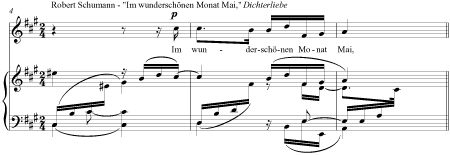
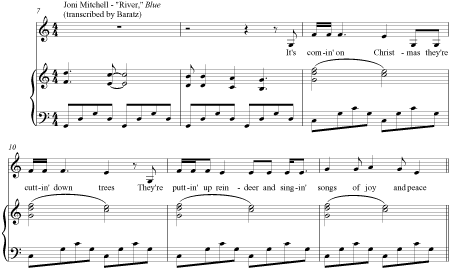
Their conceptions, though, are quite similar. Both texts clash inner anxieties with the exuberance and celebration of a new season. The tension between these two emotional territories is paralleled with a tension between major and minor modes. Where they diverge in this scheme reveals fundamental differences between the harmonic languages of the classical art song and the modern popular song.
Schumann moves from f# minor to A major with great elegance. Because the modulation doesn't alter the key signature, the transitions aren't noticed until a cadence point is reached. After the four bar introduction implies a resolution to f# minor, the next bar brings in the singer and a swift modulation to A major. The harmonic rhythm is fast throughout, with no harmony sustaining for more than a single measure.
“River,” in comparison, feels a little clunky. Rather than modulate between relative keys, it presents the two harmonies side by side. The harmonic rhythm here is significantly longer. The first half of each verse is harmonized with a C major chord that lasts for about ten seconds. It only takes a few seconds to sing the first line of “Im wunderschönen Monat Mai.”
This protracted duration gives a different kind of meaning to each harmony. Since they're given time to breathe, they're able to establish a more significant presence in musical space. They feel less subservient to a larger harmonic scheme and more like contemplative objects worthy of individual appreciation. The effect is not altogether different from a piece like Music for 18 Musicians. The drawing out of a short progression over time allows the listener to “inhabit” each harmony for a while.
The relationship between singer and accompaniment is very different in these songs. The vocal line in “River” floats on top of the accompaniment. The ideal of the art song is to entangle the two, giving them similar structural and expressive importance. Much of the expression in “River” comes from Mitchell's singing. The accompaniment in the Schumann does almost as much to shape the vocal line as the singer does. The brief harmonies color individual words, while Mitchell's harmonies color vast spaces.
This key difference evolved out of another major distinction between “art music” and popular music. While one is composer-oriented, the other is driven by performers. Though it's common for performers of popular music to play someone else's songs, they usually learn them from another's performance. Since the score is the primary document for classical music, the notes must speak for themselves more. Joni Mitchell can use simple backing for expressive vocals because her performance is the final product. Robert Schumann, tied to a less forgiving tradition, couldn't take such chances.
The resulting styles use the same triadic tonality, though in slightly different ways. Longer pop harmonies dramatize change, even as slight as I moving to vi. Classical harmony is about the ultimate destination (the similarities here between popular songs and minimalism/other “ergodic” music are striking to say the least). These two “dialects” should not be belittled either way with generalizations and value judgements, but recognized as equally valid means for tackling the same problems.
June 08, 2005
Subscribe to:
Posts (Atom)