July 30, 2006

Recent Listening

Strange and Sacred Noise is a rare example of music that I became familiar with through a score before I heard it (I spotted it on the new acquisitions shelf at school towards the end of the year). Both ways of approaching this piece are rewarding, but yield very different results. If you look at the score, it contains epigrams on violent natural phenomena, along with brief descriptions of the fractals which John Luther Adams took as "inspiration."

The CD liner notes talk about the violence bits, but don't get into too many explanations about the fractals. Granted, you don't need to understand them to enjoy the music, but it's neat to know anyway, compositional process-wise. The first and last movements, for example, are based on Cantor dust. If you look at the score for these sections, the connection to the fractal is pretty much self-explanatory (JLA has an excerpt up for viewing).

Even though the role of the fractal looks like it could have been conceived completely "on the page," I do think it's possible to hear them in performance. One notable thing about the piece is that JLA found a way to make "organic" (and audible) large-scale structures that don't rely on tried-and-true methods of symmetry and repetition (à la sonata). The moments in first movement when the Cantor dust becomes most dispersed/chaotic is truly striking, almost awe-inspiring, these little lightning bolt contours of sound jumping out of silence.

One thing I really wish had been brought up in the notes is an explanation of sacred noise, a concept which I'm assuming was borrowed from R. Murray Schafer's The Tuning of the World (a true must-read for any musician). From an article on the author:
"Noise pollution is a world problem," says Schafer. "What I call Sacred Noise is in every society. If you want to find prominent institutions, you will find that they have a certain identifying sound or a noise. And just as the tallest buildings in any cityscape are generally centres of power, the biggest noises in the city represent centres of power. And the sacred part is, because they represent power, no one is permitted to complain against those noises."
This is where Adams's piece is at its most thought-provoking. Its fractal forms provide a fairly literal translation of chaos in nature, unleashing sounds that run the gamut from the barely audible to the barely containable. By being a representation of nature, the music both illuminates it and tries to wrest control of it (the jury's still out on the feasibility of the latter). At its core, the piece is an eloquent statement of one of JLA's favorite themes: a plea for listeners to attune themselves to their environments based on the sounds in them.

Regulation

I'm of the mind that by keeping instruments in tune, you contribute to the general orderliness of the universe. Yes, the idea is as verifiable as the existence of a higher being, but I believe it all the same. At the very least, I can verify that my own mood and musical productivity took a swing up once I got my piano tuned.

In addition to getting it tuned, I had the technician regulate the action. For any non-pianists in the house, this means making a number of refinements that improve the mechanical efficiency of the instrument. When you depress a key, you are not directly forcing the hammer to attack the strings. The energy gets transferred through a few different components before the hammer goes anywhere (if the key and the hammer were attached, holding a key down would instantly dampen the sound). The regulation process gets energy losses to a minimum. Other refinements are also involved, but as I understand it, that's the bulk of it.

In musical terms, this means gaining precise control over dynamics, tone color, phrasing, and all the other nice things that help make a great performance. One other thing I noticed was that I could really feel the interaction of these components under my fingers. Definitely a neat sensation.

July 13, 2006

New Rochester Blogger

The Flower City is not known for its music bloggers. Certainly it can't compete with the vast numbers that hail from NYC, but I'd like to think that we give it a good try. In the tradition of such fine fonts of criticism as TruthMedia, please welcome Prof. Heebie McJeebie, who will be reporting from his tenured post at the Hotel Cadillac in downtown ROC.

July 08, 2006

Funny Place Names: Seattle

I was just in the Seattle area for a chamber music festival. The (musical) highlight of the trip was getting a top-notch reading of a string quartet I wrote in June. It's entitled Drapery Studies and comes in two movements (one slow, one fast). The "conceit" for the set was, as the title indicates, borrowed from the visual arts. For those who don't wander into art museums all that much, drapery studies are practice works used to hone fabric rendering skills. They are primarily technical exercises, but I was drawn to something else about the setup: a surface that covers an unseen skeleton. The contours of the cloth suggest what is underneath it, but they don't give a perfectly clear picture. The surface can bunch up in places or cast confusing light. It's all you have to judge what goes on underneath, but it is an independent entity which can easily work against your efforts.

I'm happy to say that the work was well-received by the audience at the reading (at least by the people who decided to talk to me afterwards ;) ). Even though I gave them the same "abstract" explanation of the music that I put in here, they seemed to be responding mainly to the sensual aspects of the music, which is definitely my preference. I'm supposed to get a recording back in the not-too-distant future. Assuming it turned out alright, I'll try to get it up in a public place.

Some other assorted highlights from the trip:
  • A sympathetic Satie biography by someone named Rollo (what would Charles Ives think?).
  • On the flight out, I sat next to a short, neat, Southern pilot from the airline. After I told him where I was from, he informed me that Boston was the "rudest" city he'd ever been to.
  • Indeed, whenever I get out of the Northeast, I'm surprised and confused at how goshdarn polite everyone is.
  • Seattle is built on a hill, which is really fun to walk around when you're carrying two heavy bags, one of them on wheels. Also, is it me or does every city on the west coast have a mountain as part of its skyline?
  • Hippie girl at the bus stop reading up on The Secret Teachings of Plants.
  • Port Townsend, WA (where the festival was) is full of a lot of reclaimed buildings. The downtown is all converted from Victorian houses. One place was up on the second floor of a building around a winding hallway. One pizza place was in two small rooms on two different floors (take out downstairs, sit down upstairs). If you're ordering in, food comes up by way of dumb waiter.
  • The local state park was formerly a fort. Most of its buildings were "temporary" structures put up at the end of WWII. They all come from similar Colonial-ish designs, so the complex felt a little like a housing development. Old bunkers set into the hills on the coastline are slowly getting overtaken by the foliage.
  • Middle-aged woman who hugged me after I closed my open mike set at a local bar with "Help Me" (don't worry, I didn't try to sing it).
  • The Experience Music Project, which is a church where they worship rock music. They even have relics. However, instead of a piece of the true cross, they proudly display a piece of a guitar that Hendrix smashed. Really shows how personality and style are a major part of the music.
  • There I also got to see my first Trimpin piece. Imagine a tornado of guitars blowing through the main atrium of a building. Some of the guitars are played by MIDI-controlled robots. Put on headphones and hear a medley of songs in different styles. The visual component was great (you can see all the guitars getting played), but I was a bit underwhelmed by the musical experience. I think it would've been more impressive if you didn't have to put on headphones to hear it, so there was a direct connection between the visual and the aural.
  • Taking the red-eye back, which disturbed both my sleep cycle and my sense of time! (wait a minute...)
With all that said, I'm through my "R&D" period of writing just piano music. Right now I'm getting into a piece for string orchestra to give me a large ensemble piece for grad school apps. How I look forward to those...

June 23, 2006

Charlemagne Palestine in Boston

Monday night was the kick-off concert for NEC's SICPP week. Stephen Drury presented Morton Feldman's Palais de Mari, followed by Charlemagne Palestine presenting his own Golden Mean. Drury's playing was very lovely. Though score for the piece is dry on dynamic markings (except for the initial ppp and some cryptic decrescendos), he tastefully added swells during some moments. Rather than evoke a Romantic sentimentality, it suggested more a shifting luminosity, the sun emerging from beneath clouds and casting a more golden light on the scene.

He really captured the piece's sense of vertical time. Listening to it is like exploring ancient ruins. One's thoughts are caught between the present and an imagined past. Time seems to bend accordingly. When you finally leave the area you feel as if you were there for only a brief moment (and accordingly, are humbled by that reality).

Though I hardly object to the number of Feldman recordings that are available, this recital was a reminder that the concert hall is really the best place to hear his music. The physical reality of the sounds permeating through space is an essential part of it. I don't mean this in a Cagean sense of taking pleasure in sounds as they are, but that this movement seems an important part of the piece's conception and orchestration. Drury evenly balanced its experimentalism with a sense of its connection to the classical tradition.

Palestine's set was begun with a little more fanfare. He was no doubt responsible for the giant crowd that was there (people had to stand in the aisles). At the beginning of the night, Drury thanked him for the best audience he's ever had. Note to hipster-seeking performers: an interview in the Dig is a sure way to round them up.

Everything you've heard about his playing style is true. Yes he has stuffed animals all around the pianos, yes he's a flamboyant dresser, yes he drinks cognac while playing. Despite his anti-pretentious habits, I was struck by his professionalism when setting up his mise-en-scène. He placed all the animals very quickly and intently.

He became more relaxed once his performance began. He opened with a few minutes of remarks, talking about the varying reception he's gotten over the years, definitely framing himself as an enfant terrible. He said he was glad to see that there was a new generation who was open to his way of hearing sounds. He talked a little about how his relationship with Feldman (the similarities end with them both being Russian Jews from Brooklyn), and made the usual comment about how much Feldman's personality differed from his music. This struck the audience as a joke, to which a surprised Palestine explained that he was just stating the facts.

He began playing by creating a drone by running a finger around one of his glasses. After a little, he sang along with it (he explained beforehand that he always got into a trance state before playing). Golden Mean begins as a motoric unison (using two pianos) and expands to a variety of other similarly hammered out sounds.

His interest seemed to be not in the fundamental pitches, but in the elusive harmonies found in the farther reaches of the overtone series. He didn't always play both pianos at the same time, though their sustain pedals were weighted down so they would always resonate. At a few points, Palestine sang in a modal fashion over the pianos, usually vocalises or what sounded like Hebrew. He cried "sound is sound!" a number of times throughout.

Palestine seems very concerned with creating a spiritual music. I think he would agree with Feldman and say that sound is his only deity, but they definitely have different notions of what that deity is. Palestine's music, despite its flirtations with Eastern thought, struck me as being very animist. All his hammering seemed like it was trying to tap the same energy reached by the man-animal deities that surrounded the pianos.

The audience's reaction to him was raging, loud and effusive (hipsters being hipsters, I suspect his swashbuckling stage manner and theatricality, with its dips into childhood imagery, had a lot to do with their enthusiasm). He shouted "sound is sound!" a few more times as he paced the stage, closing the show.

June 14, 2006

SICPP 2006

Via Sequenza21, I hear that NEC's annual new music for piano festival is going on next week. The concerts last year (featuring music of Rzewski) were terrific. I can only assume that this year's will be at a similar level. The first night looks like a knock-out, featuring neo-animist/minimalist Charlemagne Palestine performing his own music. His appearances were supposed to be getting increasingly rare, so the fact that he's appearing in a conservative enclave like Boston is pretty astonishing. On the same night, Stephen Drury is going to be playing Feldman's Palais de Mari. I can't wait to hear that one live. The full schedule for the week is up on NEC's online calendar.

Out of Context?

Just how do advertisers find the music that accompanies their work? Recently, I've been witness to "Mack the Knife" accompanying a shrimp promotion and "I Think I Need a New Heart" being used to hawk dog food. I can only imagine the conniptions that Brecht and Weill are going through, but I hope at least that Stephin Merritt's dog will never go hungry again.

These recontextualizations make me wonder how much of a piece's meaning is defined by its use. The "True Crime Stories!" (mit alienation effect) angle of "Mack the Knife" was thrown away to focus on the music's swinging sound. Really, any piece with a swing and added 6 chords would've worked. My initial reaction to the ad was "How can they not get it?!?!" Still, I can't help but be amused by the song's slippery history: agitprop to jazz standard to memory of a jazz standard. For all we know, an industrious sampler has isolated some fragment of a recording of the tune and is using it to jumpstart a new genre of dance music (it's happened before).

As performers and listeners, we are responsible for bringing the notated music back to life with each performance. By participating in this process, are we not entitled to a few small acts of re-creation along the way?

June 05, 2006

Songlines

In theory, at least, the whole of Australia could be read as a musical score. There was hardly a rock or creek in the country that could not or had not been sung. One should perhaps visualise the Songlines as a spaghetti of Illiads and Odysseys, writhing this way and that, in which every 'episode' was readable in terms of geology.

...

It was one thing to persuade a surveyor that a heap of boulders were the eggs of the Rainbow Snake, or a lump of reddish sandstone was the liver of a speared kangaroo. It was something else to convince him that a featureless stretch of gravel was the musical equivalent of Beethoven's Opus 111.

By singing the world into existence, he said, the Ancestors had been poets in the original sense of poesis, meaning 'creation'. No Aboriginal could conceive that the created world was in any way imperfect. His religious life had a single aim: to keep the land the way it was and should be. The man who went 'Walkabout' was making a ritual journey. He trod in the footprints of his Ancestor. He sang the Ancestor's stanzas without changing a word or note — and so recreated the Creation.
Bruce Chatwin, Songlines.

May 24, 2006

When will Dr. Thorpe write "Your Composer Sucks?"

Mmmm, levity. Another reminder from SA to never take anything too seriously.

May 18, 2006

Winding Down

Here I am, another blogger reemerging after the end-of-semester wrap-up. Diehard readers will be glad to know that I managed to sneak in a little extracurricular musical analysis between finals. I'd been listening on and off to William Duckworth's Time Curve Preludes for a little while now, but only recently got a chance to check out the score. In case you're not familiar with the music, they're tightly written piano pieces that rarely cross over the three minute mark. On the surface they sound minimalist, but they do not dramatize process in the same way early works by Reich and Glass do. Duckworth's music is usually classified as "postminimalist."

As the Wiki entry indicates, one of the major differences between minimalism and postminimalism is how they interface with other styles. Echoes of popular music are all over Reich and Glass, but their personal styles dominate the texture. No one's going to mistake any of Duckworth's preludes for a genuine bluegrass piece or a snippet of North Indian classical, but when other styles poke their heads out, they're allowed to stick out. The reason he can do this is because of another major difference between minimalism and postminimalism: how the structure relates to the materials.

Think about the iconic riff of Piano Phase. As it slides again itself, new harmonies and melodies emerge. Reich didn't choose any old motive. He wrote one that would react well to the phase process. The structure and materials are "codependent" in a way. Throw any old diatonic motive into the same format and the results won't be nearly as good.

Duckworth's structures are (to a degree) indifferent to the musical material. They can be seen as processes, but they operate more on durations and phrase lengths than harmony and melody (the latter two being strong indicators of style). For a moment, let's say we're not talking about music, we're talking about a special kind of poetry written using a process. Our "pre-compositional material" will be a sentence, which we'll write down on a piece of scratch paper (so we mangle it readily along the way). We then follow these steps:
  1. Copy out what's on the scratch paper
  2. Cross off the first word on the scratch paper
  3. Repeat steps 1 & 2 until all the words on the scratch paper are crossed off
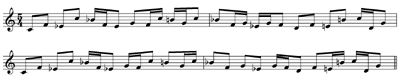
So if our germinal sentence is "My dog has fleas," our "poem" is "My dog has fleas dog has fleas has fleas fleas." Replace words with measures of music, and you've got the basic backbone for some of the Time Curve Preludes. The "sentence" for Prelude II looks like this:

The Time Curve Preludes - II

The barlines break it down cleanly into four parts, with two of the parts being slight variations of the other two. The process for the prelude cuts down the material one beat at a time, allowing it to stretch out over a couple minutes. The poem we wrote doesn't obscure the process that created it, but the repetitions embedded in this musical material do. While one bar is getting chopped up, you hear it seemingly intact just a few seconds later. Only at the very end, when the last bar is getting taken apart, does the process become more apparent.

While the right hand works on this modal figure, the left hand plays a tala-ish accompaniment: a 20-beat pattern on Cs (similarly divided into two equal halves that are only slightly different from each other). This pattern is constant throughout the piece, lending interesting rhythmic counterpoint to the right hand's gradually diminishing phrases. The two hands finish together at only two points: after the first statement of both 20-beat figures and at the end of the prelude.

April 24, 2006

Nonken Interview

Theater blogger George Hunka has an interview up with pianist Marilyn Nonken. She's the one who did the Mode recording of Triadic Memories. I first came in contact with her playing when I heard a recording she did of a shortish Babbitt piece. She possesses the seemingly rare skill of being able to make his music poetic. The interview covers how she thinks about physically presenting herself when playing in order to make her performances more compelling. Good stuff.

April 07, 2006

Recent Reading

I think it's just a coincidence that I read Sexual Personae (Camille Paglia) and Opera, or the Undoing of Women (Catherine Clément) at the same time, but they ended up pairing very well together. Both of them discuss the sexual forces that motivate art (the art itself and its creation). They both share the pretense that they are stepping back and taking a broader look at the work they are considering than most other commentators. Clément sees misogyny from her vantage point. Lots of it. Paglia finds misogyny, but also transvestism, polyamory, vampirism, and an assortment of other behaviors that you probably don't discuss in most lit. surveys or music history classes.

To Clément, art is more or less a pissing ground for bitter, insecure men. Paglia sees a battleground for the irrational forces that society was meant to guard against. For her, misogyny is a fact of life. She isn't rushing to get the bumper stickers on her car, but she states that it's basically the reason Western civilization and culture exists. If women were in charge, we'd still be living in grass huts.

In case you haven't guessed, I found Paglia's arguments more compelling. They weren't always the most well-documented (many of her explanations boiled down to "because I'm Italian"), but when measured against my own experiences in and outside of art, they made the most sense. Clément seemed to be the truly embittered one, interminably pissed off that the operas she loved as a child turned out to mean more than she thought they did.

Perhaps less contentious ground was covered in Music Downtown, Kyle Gann's collected criticism from the Village Voice. Danny Felsenfeld did a thorough write-up for NewMusicBox on why unabashedly subjective criticism is a Good Thing, so I don't need to repeat what he already said so well. I only wanted to comment on one of the book's recurring topics. "Imagism" is Kyle's term for music that presents sonic images that stick into the listener's memory. It is a device not tied to a particular aesthetic movement: Fate knocking at the door of Beethoven's Fifth, the pure G major triads that occasionally surface in the "Thoreau" mvt. of the Concord Sonata, Stravinsky's instrumentation for the cadenzas in his Concerto for Piano and Winds (he doesn't recognize Debussy or Ligeti for their image-making abilities, but that's one feature of their music that's always stuck in my mind). Part of his presentation of the idea is that images help listeners immensely in making their way through a piece and that they're sorely lacking from Uptown music.

Feldman is cited as a preeminent "imagist," but in the process, Kyle makes an odd injunction of his Jewishness: "Within white culture, perhaps only a Jewish composer could have pulled off such a feat [reintroducing images to music]; not a hyperrationalist Jew like Babbitt, but a Talmudic mystic with respect for the unutterable" (263). Though Jews are "overrepresented" in music, Jews are less present in the visual arts. Kyle says that Christianity banished pagan images from its practices, though the stereotype of churches in my mind includes stained glass and visual depictions of the life of Jesus. I've never seen much visual art in synagogues, but I've seen more than one Torah proudly displayed for its highly disciplined caligraphy. We love words.

When you get into Jewish mysticism, as viewers of Pi may recall, words start to gain tremendous power. The golem of Prague was brought to life by writing emet (truth) on his forehead. Erasing the first letter changes the word to met (death) and puts the golem to rest. To me, Feldman's declaration of sound as the deity in his life and his desire to not "push the sounds around" are indicative of this deep respect of the power of language. Though perhaps Kyle was right to link this part of Feldman's style with his Jewishness, I'm not sure that the connection he made was quite complete. Sorry if it seems like I'm quibbling with technicalities here, but I think that's a Jewish thing, too.

One more point of comparison, on Feldman's "Jewishness":
Once there was a gentile who came before Shammai, and said to him: "Convert me on the condition that you teach me the whole Torah while I stand on one foot." Shammai pushed him aside with the measuring stick he was holding. The same fellow came before Hillel, and Hillel converted him, saying: "That which is despicable to you, do not do to your fellow, this is the whole Torah, and the rest is commentary, go and learn it."
vs.
My past experience was not to "meddle" with the material, but use my concentration as a guide to what might transpire. I mentioned this to Stockhausen once when he had asked me what my secret was. "I don't push the sounds around." Stockhausen mulled this over, and asked: "Not even a little bit?"

March 25, 2006

Performance Alert

This coming week, Eastman is playing host to a Women in Music Festival. On Monday the 27th, I will be making a contribution in the form of my piano version of Joni Mitchell's "Blue Motel Room." Since it is among her songs that lean strongly in the direction of jazz, my version will be partially improvised. I'd rather not be in the business of staging museum-quality reproductions, anyway. CD players do such a much better job at that sort of thing.

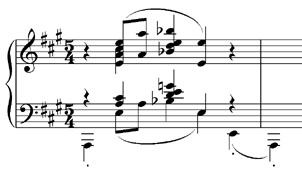
Before signing off, the theory nerd in me wishes to share a few observations about the song. "Blue Motel Room" falls into an AABA form (played twice). One interpretation of the harmonies spells some of them as triads with extensions. This style aids readability, but it disguises some of the progression's inner logic. Another way of spelling the chords uses descending parallel triads with altered bass:

Triad:CFEbdDbcFC
Bass:CGFFEbEbGC

The chords make more sense as a linear descent than if you tried to attach Roman numerals to them. There is still some tonic-dominant polarity lurking about, though. The bass for the second-to-last chord jumps up to ^5 and has a clear dominant functions. The chord itself is a funny hybrid, a subdominant-as-dominant, but with ^5 in the bass.

Why is the linear descent broken up? What would happen if a d harmony was substituted for the F/G there? I have two thoughts on why she made this decision. First of all, it gives some contrast to the progression. If it was one long linear descent, you'd lose a sense of tonic after a while. The resolution to C at the end would feel like less of an achievement.

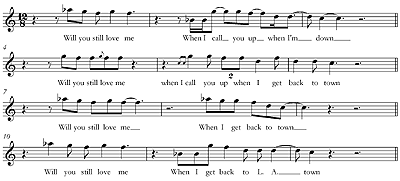
The other possibility is that the tonic always seems in danger of slipping to Bb. Bb and Eb appear in enough of the harmonies that it would be very easy to modulate there if you tried. When I was first working out the voice leading for the changes, I made some inadvertent modulations to Bb major. Sticking in the F/G chord makes it clear that, at least for the time being, the song is staying in C. The resolution to the tonic at that point feels like an act of restraint, well-suited to the insecure lyric there: "Will you still love me / When I call you up when I'm down."

The unstable tonic seems to explain why the B section opens with a BbM7 chord. With this move, the lyrics change from personal insecurities to demands and accusations directed at the unnamed lover. She's no longer holding back quite as much. The lyrics in all of the A sections stick to personal reflections on the emotional strain of being away from home and the man in question (a conflation of emotional and physical dislocations is a central theme of the album). The B sections get more specific about the relationship in question (but only slightly — still more restraint): "You and me, we're like America and Russia...", "You lay down your sneaking round the town, honey / And I'll lay down the highway."

One last thing. No fancy analysis, just my amazement at the range of expression you can get by altering the delivery of a line:

March 09, 2006

Looking for some sightreading?

I'm not anymore. Daniel Wolf posted at Renewable Music to say that Larry Polansky has a number of PDF scores available for free perusing and printing, including the massive "Lonesome Road." I wish more composers would make their music this readily available.

I've made it

Courtesy of Site Meter, I have a limited ability to see who passes through these pages and what might've led them here. For the most part, people wander in from other blogs. Searches also draw in a number of people. Because search terms are embedded in the referring URL, I can see what they were. Earlier today, a search for "blondie cartoon incest" led someone to this (what I thought) family-friendly blog. I'm assuming my earlier post on R. Crumb was responsible for this. Ignoring this visitor's sexual predilections for the moment, does it really only take one mention of R. Crumb to bring out the deviants?

Piano tuning fun has continued, albeit with a slight break for Midterm Mayhem!! Curiosity led me to getting out the library's copy of the greatest book ever (OCD sufferers are advised to stay away). Further curiosity led to some experimentation with the Thomas Young (well-) temperament of 1799. It didn't take long to realize how superior non-equal temperaments really are for playing tonal music. Keys really have distinct characters, intervals in general sound better, etc., etc., etc.

I'm wondering now about an issue in listening to tonal music: modulation. In all of my music history classes that covered tonal music, discussions of significant modulations always prompted someone to ask, "I can't hear this. Could people back in [whatever period] really pick up on it?" Each time, regardless of prof., the same answer: "Well, listeners then were much more attuned to these harmonic procedures."

Something about this answer always seemed...fishy. My current theory: it's hard to notice modulations within equal temperament because every key sounds the same. A temperament with distinct key characters makes it easy for listeners to notice modulations. When the quality of the tonic suddenly changes, you know you're in a different key. Do you even need relative pitch to figure that out? Consider the beginning of the Debussy prelude, "Les sons et les parfums tournent dans l'air du soir":

Debussy - Les sons et les parfums tournent dans l'air du soirWhen the piece modulates to Ab major, this melody, with identical harmonization, comes back. While the modulation is handled with the utmost smoothness, modulating by semitone definitely falls outside the bounds of common practice tonality. In the context of equal temperament, though, any modulation made with enough common tones sounds acceptable. Is it significant that Debussy chose a new key that neighbored the tonic on the chromatic scale instead of the circle of fifths? If you think of modulations as large-scale dissonances, then you get keys that clash by semitones instead of fifths.

I'm guessing someone could pull out more links between equal temperament and Debussy's harmonic practices. Thinking more generally, what are other ways of "dealing" with working in equal temperament? You can...
  • ...reshape functional harmony to work more effectively within the constraints of equal temperament (à la Debussy).
  • ...build a harmonic system around the understanding that all 12 tones are equal (à la Schoenberg).
  • ...downplay functional harmony, instead constructing music around rhythm/timbre/texture/etc. (take your pick).
Did I miss anything?

March 01, 2006

What makes a composer?

The latest "issue" of NewMusicBox is out, with Joan La Barbara getting the interview love this month. The article didn't have any big surprises*, but it did have an interesting quote:
So I was really intrigued by the idea of working with living composers, with people that I could have a conversation with, discuss ideas, use my brain in a very different way. Contemporary music fulfilled that for me. I could discuss [a piece] with a composer while the music was still being written and have an influence on what the piece was going to be. Actually my last vocal teacher, Marian Szekely-Freschl, said to me, "You must work with composers. You must help them because they don't know how to write for the voice." And so I really felt as if this was one of my responsibilities. And then as I was working more with composers I realized that I had ideas of my own that were not going to get heard unless I became a composer, so these things developed sort of simultaneously.
It's kind of an assumed notion that divine inspiration/in-born gifts are necessary to be a composer. It's nice when people give you that wide-eyed impressed look when you tell them you write music, but it's a shame that so many people see musical creation as an off-limits activity. Every now and then, you're lucky and hit on an idea that makes you feel like a capital C-Composer, but most of the time I see composition as something that one does either because music/sound is your native language, or because you're so opinionated about music that it was only a matter of time before you tried your hand at it.
---

* No big surprises, unless you didn't know that she was a composer as well as a singer. If this is news to you, make haste to UbuWeb and listen to 73 Poems.

February 21, 2006

What is art for?

I have the answer! Er, an answer, via Louis Andriessen, who gave a masterclass this afternoon as part of his visit this week to Eastman. He cited Kierkegaard's definition of irony (pardon me if I botch it), where actions and events have multiple plausible causes, and one is made strongly aware of this unresolvable multiplicity. He gave (wait for it...) Stravinsky as an exemplar of this virtue. Stravinsky frequently takes ideas in unexpected directions. This puts the listener in a bind, not altogether sure why this happened or what the composer's motivation for the whole thing was.

The purpose of this ambiguity is to get you to ask questions, not to provide easy answers. Andriessen said that art's role should be in reminding you to ask various important questions that you might otherwise neglect. Art focused on conveying emotion/feeling (à l'Allemand) will always reduce down to the same syrupy sentimentality.

While I don't let my internal Angst-meter give the final verdict on a piece of art, I don't hold the same level of disdain for emotional expression. Sometimes emotionality is the only tool available for posing certain important questions. The vulnerability that's in so many Kenneth Patchen poems makes you ask if you're always true to yourself. Probably Andriessen's contention was more with putting in emotion for its own selfish sake. No problem there. The world doesn't need any more whiny break-up songs.

Elsewhere on the sentimentality front, I received a startling newspaper clipping in a recent dispatch from home. In the arts section of the 2/12 edition of the Boston Sunday Globe, they devoted 3/4 of the page width and the entirety of its length to a couple features and smaller factoids on Arnold Schoenberg. Levine's decision to program a series of all-Arnie concerts was responsible for this wholly remarkable level of coverage. Further in the section, the title of one of the articles informs us that "Programming proves a boon for modernists." After this victory, what lies next for this wily lot of lunatics and rabblerousers? I'm seeing "Modernists implicated in opera house bombing" plastered across the front page.

February 19, 2006

Tuning Lesson, and more

Sorry it's been a while since I've posted. A minor wave of schoolwork, plus wanting to finish off a substantial song cycle that I've been working on for a while (more on this later) have kept me away from the ol' soapbox.

A couple days ago, I began my self-instruction in the art (definitely not a science for me just yet) of piano tuning. It seems like something all pianists should try at least once. Getting to encounter temperament as a practical rather than historical/theoretical issue gives one a much different understanding of the matter. What made the experience especially wonderful and occasionally overwhelming to me was the very intense tactile relationship I got with sound. I say tactile, because with so much of my musical life spent in front of a piano, I tend to think of music as something one interacts with through touch. Instead of "touching" a quantized set of pitches (12TET), I could push around the 12 tones to wherever I wanted them to be. It's the same as the difference between homebrewing/making your own bread and going store-bought all the time.

NB: If I post in a few months about how 12TET is unbearable sewage to the ears and how I've started composing in a new and wholly impracticable scale of my own devising, this is where it all started.

Random observation: Kyle Gann's posts on "metametrics" haven't been picked up too much by people in the (post-)classical end of the blogging world, but they've found (at least) a couple big admirers in the jazz world. Will post-minimalism and totalism find second lives among jazz composers?

The song cycle I just wrapped up sets six poems from Facts for Visitors. It's a pretty big piece (the biggest for me yet) — 18' of songs and interludes for tenor/fl/ob/hrn/bass. The texts deal primarily with "miscarriaged" relationships, damaged either through personality conflicts or something more unusual. The narrator usually involves himself in the relationship in a peculiar way. "Everything" (the first poem I set), describes a "relationship" between two people who never met. The narrator implies that they might've become close if they did actually meet, but they were both "victims of circumstance."

In the texts (particularly in "Everything"), the narrator is more attuned to the little behaviors that push around these relationships than the people who are affected by them. The way I read it, had these people been more attuned to each other, they would have been more likely to live happily ever after. The sequence I used starts off with a relationship at its most disconnectedness (description of problem), moves into the consequences of not paying attention to other people (development and climax), and finishes off with an example of two people who appear to connect for a moment (resolution/conclusion). This progression is the definition of tried-and-true, but I'd rather be understood than be clever. I initially had some structural ideas that better reflected aspects of the poetic content, but they were more easily seen than heard.

While I deal with getting this project performed, I think it's time to spend a little time in R&D (i.e., doing lots o' piano music). Big/bold/dramatic/rhetorical is fun and satisfying to put together, but now I'd like to go after something a little different.

February 05, 2006

A rose by any other name...

William J. Schafer:
[Harry] Nilsson and [Randy] Newman represent a musical literacy alien to the funky scuffling spirit of Liverpool or Memphis. Their music is basically classical—it catalogs and orders the scattered materials of pop musical culture.
Robert Ashley:
If a piece of music is under three minutes long, it's rock. Over three minutes, it's classical.
While not that useful for critical discussions, I'm in favor of Duke Ellington's system:
There are two kinds of music. Good music, and the other kind.

January 28, 2006

Completism/iPodism

Zoilus has a little round-up of articles on the influence of the iPod on how people listen to music. One of the pieces takes the issue of music as a commodity in a slightly different direction. Basically, as more and more labels release alternate tracks, old bootlegs, and complete sessions of albums, our enjoyment of the original releases is reduced.

If you're one to fetishize albums — spending hours staring at the cover art, reading and rereading the liner notes, forcing your friends to listen to the same tracks again and again — I can see how this situation would be a problem. To maintain your obsession with the album, you have to keep yourself in a perpetual state of ignorance about how it was put together. You may say you want to know "how it all happened," but by exposing yourself to the banality of the circumstances, the mystery will disappear completely.

If you give into the temptation to hear the original demos and studio sessions, you can't romanticize the process of creation any more. It becomes evident that the music you love was birthed through hard work. As the PopMatters writer pointed out, you realize that the Beatles recorded a lot of duds. When you hear the official release of SMiLE, you wonder whether it was worth the 30-year wait.

The article does not touch on the segment of the music listening population that wants to know what it takes to put out an album of legendary status. You know, wouldbe songwriters, producers, and probably a few composers. Beyond the simple lesson that hard work and dedication go a long way, you can piece apart the sessions and learn how the tracks were put together. You can examine multiple versions of songs and figure out what made the final version so great.

Artists in other media get copious opportunities to pick through the creative process. At a big retrospective exhibit of a major painter, you usually get to see sketches for his magnum opus, along with any canvases he may've done that didn't pass muster. Do people who see these "lesser works" go up the ticket window and ask for their money back? Pop music fans should be thrilled that this kind of opportunity is now available on such a large scale.

As far as the impact of iPods go, I don't think the situation is as dire as it's made out to be. Among any population of self-proclaimed music lovers, you'll have two groups: people who say they like music, and those who actually do. The people who only say so are put up to it by the same social pressure that foists any other kind of fashionable behavior on them. The other group, whether they're into it for the artist worship or the admiration of craftsmanship, will never give into a music-as-wallpaper lifestyle, no matter how much technology gets thrown at them.